Geotechnical design
Overview
Design options for safety, constructability, and economy from site and structure conditions
Scope
Six fields: slope, soft ground, tunnel, foundation, port/river levee, seismic
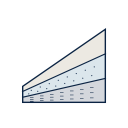
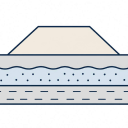

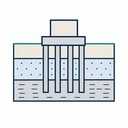
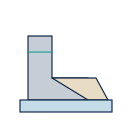

- Slope — groundwater, limit equilibrium, and numerical stability measures
- Soft ground — physical, mechanical, and consolidation properties for improvement and settlement
- Tunnel — alignment, section, excavation, support, lining, and stability
- Foundation — type selection, method comparison, bearing, settlement
- Port / river levee — foundation method and long-term stability
- Seismic — criteria, liquefaction, and dynamic stability
Slope design
Soil and rock slope measures from groundwater, limit equilibrium, and numerical analysis
- Design flow — conditions → stability analysis → reinforcement or slope flattening
- Groundwater — rainfall in limit-equilibrium; saturation depth in seepage analysis
- Limit equilibrium — factor of safety from block weight, joint friction, cohesion, pore pressure
- Geometric analysis — joint-set sliding and stereonet failure potential
- Numerical analysis — joint contact, FDM stress-strain, shear failure and plastic zone
- Measures — flattening, nailing/anchor, and related options
Soft-ground design
Improvement methods and settlement/stability design from physical, mechanical, and consolidation properties
- Design flow — properties → method selection → consolidation settlement and stability
- Physical properties — Atterberg limits, natural water content, mineralogy
- Shear strength — vane, piezocone, uniaxial and triaxial undrained strength with depth
- Consolidation — standard, CRS, Rowe-cell, and long-term tests
- Methods — preloading, vertical drain, vacuum consolidation, SCP, and others
- Settlement and stability — linked to soft ground improvement and analysis
Tunnel design
From planning and investigation through section, excavation, support, lining, and stability
- Planning and investigation — alignment, surface geology, in-situ and lab tests, rock classification
- Section — single/double track, arch, clearance, drained/undrained
- Excavation and auxiliary — blast, mechanical, NATM, shield/TBM, weak-zone support
- Support and blasting — pattern and quantity; noise and vibration from trial blasts
- Lining — thickness and reinforcement from structural analysis
- Stability — adjacent facilities and constructability
Foundation design
Type, method, bearing, settlement, and 2D/3D numerical reliability from ground conditions
- Design flow — investigation → type/method → bearing and settlement → 2D/3D analysis
- Type — shallow, pile, caisson from depth, load, and site
- Pile methods — pretensioned (PHC etc.), bored, and others — constructability, noise, bearing stratum
- Bearing and settlement — empirical/theoretical upper bounds vs design load
- 2D/3D analysis — group-pile behavior, abutment lateral flow, staged construction
Port and river-levee design
Foundation method and long-term stability from natural conditions, cases, and economy
- Design flow — natural conditions → foundation method → stability
- Foundation method — replacement depth, parameters (MCS, BA), bearing stratum, water depth
- Treatment comparison — replacement, GCP, SCP, DCM — residual settlement, drainage, constructability
- Stability — bearing, settlement, seismic and port-design criteria
- Maintenance — instrumentation plan and handover
Seismic design
Seismic class and design ground motion, liquefaction, and dynamic stability
- Procedure — class and motion Visit the EGEIT website response → liquefaction and dynamic stability
- Criteria — importance and performance; seismic zonation and hazard
- Dynamic properties — MASW, S-PS, SCPT shear-wave velocity and site class
- Liquefaction — grain size, SPT, modified Seed & Idriss; cyclic triaxial if needed
- Dynamic stability — pseudo-static, total-stress, effective-stress; 2D/3D deformation (SSI cases on analysis)